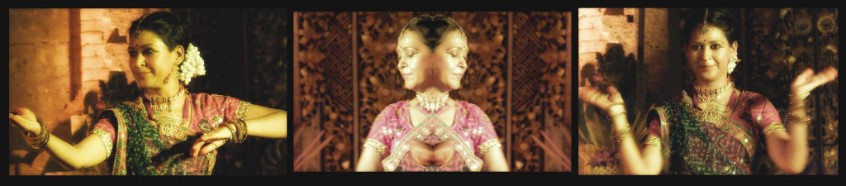
 Sampravaahi |
||
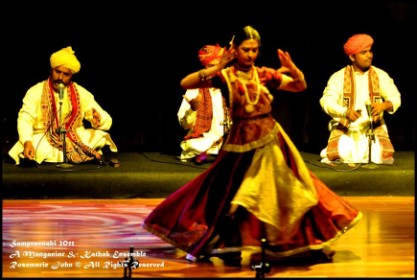
The Idea behind the presentation of Sampravaahi is, to bring to the fore, music that is authentic and not often heard, musical gems that are in danger of being lost amidst the more popular and, sometimes, very garish versions sold in commercial packages in the name of Rajasthani folk music. The group’s repertoire includes some rare and complex compositions in 14, 10, and 6 beats time cycles, and traditional folk and Sufi songs and melodies from the Manganiar tradition. The Concept behind Sampravaahi is not that of any kind of attempted fusion but rather that of a very bold and close interaction between the two streams, so that what meets the eye is pure Kathak dance, and what is heard is, by far and large, Folk music and song. This kind of interaction is evidenced variously, as in a 14 or 7 or 10 beats lehra kept by a folk artist on the Kamaayacha and Saarangi (string instruments), and not, as is usually done, by a classical Kathak accompanist to accompany Kathak todaas in the middle of a song; a spontaneous jugalbandi with all the folk percussion instruments such as the Khartaal (wooden castanets) and Dholak (drum) and the dancer’s ghungharoos (ankle bells); an understanding and usage of Rajasthani rhythms by the Kathak dancer and the usage of style of movement of Rajasthani folk dancing. The Dance Choreography in Sampravaahi attempts to blend in the classical grammar of Kathak dance in a subtle rather than an obvious and forced manner, so that the mood of the song and music and its Rajasthani base and spirit reaches out to the audience intact.
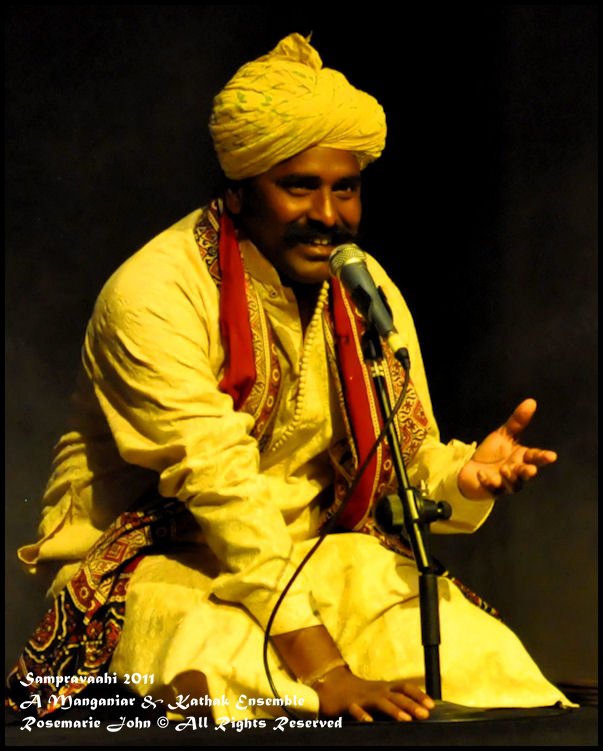
A note on the featuring Music and Dance / Choreography Manganiar Music Tradition Rajasthan comprises a big landmass, abutting on several important cultural zones: Sindh and Punjab (the former, and part of the latter, now in Pakistan) to the west and northwest, Gujarat to the southwest, Malwa to the southeast, Braj Pradesh, that is, mid-western Uttar Pradesh, to the east and Haryana to the northeast. Interaction with these cultural zones has invested Rajasthan’s folk music with diversity and a great variety of forms and musical instruments. More particularly, the melody of the Middle East comes winging to the western borders of Rajasthan via Sindh. In our presentation, we are primarily focusing on the
music of southwestern Rajasthan, namely the districts of Barmer and Jaisalmer,
which in the main is the music of the hereditary Manganiar musicians. Some
noteworthy features of their music are these : they represent the meeting
point of the folk and the classical, mentioning raag names (like Jog,
Shaam Kalyaan, Dhaani, Bilaawal, Sorath, Khamaaichi, Saarang, Maand,
Sindhi Bhairavi and Kaafi) and employing aalaap, murkies, tihaais
and taan-like sallies, displaying advanced consciousness of rhythm and
melody, that is, laya and sur, although the classical overtones
are mostly incipient and rudimentary, rooted in inherited and acquired
dexterity rather than in grammar; their rich repertoire includes Jaangada, a distinctive song – type that,
inter alia, employs Dingal poetry and is an exacting form to be rendered
in a vigorous style that calls for musical skills of a high order, devotional
songs by saint - poets like Meera Bai, Kabir and Soordas and compositions by
Sufi saint - poets of Sindh, songs about legendary figures and ballads concerning
them, for example, Moomal - Mahendra, Dhola - Maaru, and Lakhaphulani.
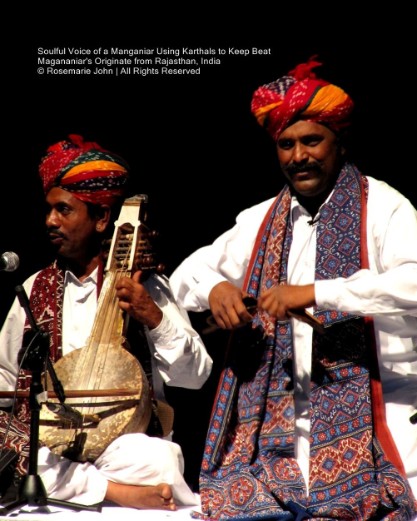
Musical instruments such as the Dholak, Kamaayacha, Saarangi, Khartaal,
Harmonium, Sataara (twin flutes), Morchang and the Dhol are some of their main
musical instruments. Jaipur Gharaana Kathak Tradition Kathak is the major classical dance form popular in northern India. The word 'katha' means a story, and hence, Kathak is 'the art of the story teller'. It is a partially narrative dance form characterized by complex and fast footwork (tatkaar), spins (chakkars), and innovative use of enacting techniques (abhinaya) to give expression to a story, sung text or emotions. It has, today, a form that has been influenced at various times in its history by the art of mythological narration or katha-vaachan by ancient bards or kathakas; temple dances; Rajput and Rajasthani cultural milieu due to patronage in courts of kings of Rajasthan; the Bhakti Movement, both Vaishnav and Shaivite; and, the Persian influence of the Mughal courts. This also caused the origin of the four Gharaanas or schools of Kathak - the Jaipur, Lucknow, Benaras and Raigarh Gharaanas - collective traditions of stylistic specialties passed on to generations of families or disciples, and so named after major cultural centers that their pioneering exponents received patronage in, and whose cultural influences stamped their art indelibly. Kathak performances are a combination of two components - nritta and nritya. The former, the so-called 'technical' part, is abstract dance with a tremendous sense of rhythm and joy of movement. The beauty of this part of Kathak lies in the exact rendering of the rhythmic patterns mainly chosen from an inherited and meticulously learnt repertoire of syllabic dance compositions (bols), but also improvised rhythmic patterns or those given by the accompanying percussion instruments, through both graceful and vigorous body movements and mastery of the artist's footwork. The second part, the nritya, uses abhinaya or enacting techniques like facial expressions, hand gestures and symbolic body postures set to rhythm (laya) and music. Kathak as a dance form is not rigid in style. It allows the artist a spontaneous use of a variety of movements, thus leaving scope for interpretation of the pure dance or a story through the dancer's power of imagination and improvised creativity or upaj. The Jaipur style of Kathak was nurtured in Rajasthan, receiving patronage in courts of kings of Jaipur, Jodhpur, Bikaner, Alwar, and other prominent erstwhile native states. It was greatly influenced by the Bhakti cult and temple art and culture, since temples in Rajasthan employed pakhawaj players, singers and dancers in the service of god, and shows a marked leaning towards the devotional and the subtle in content and style of abhinaya or expression rather than the worldly and erotic. There is a greater incorporation of parans - compositions based on syllables of the pakhawaj, and kavitts - compositions with poetry and dance syllables combined together. This style also traditionally places importance on the more technical aspects of Kathak dance such as powerful footwork, multiple spins and long complicated compositions (lamchads) in different taals. There are so many varied styles within the Jaipur Gharaana itself, propagated by all major nrityacharyas and followed by their shishyas or disciples. But in spite of the variety, the entire Jaipur Gharaana has, in common, certain features, the major ones being - an in depth treatment of any taal in vilambit laya or very slow paced tempo; the emphasis on energy and vigour in movements characterized by the famous paran ang of its repertoire; varied and charismatic use of spins or chakkars; certain very characteristic bols like the 'traam thei thei ta thei' - uthaan thaats and the various paran aamads; unique footwork, that places emphasis on both feet being used equally for detailed nikaas or execution of bols; dancing a wide repertoire of kavitts; subtle abhinaya, that, one would say, seems more felt and introverted, and devotionally inclined - it is still very much a part of Rajasthani culture today to hold Kathak performances for the deity in major temples; and, not the least, a unique beauty and grace that is akin to the stately grace of Rajasthan's folk dance movements. |
    |
|

|
